

Living on a boat, off the grid, low-tech, freedom.
This is a listicle style blog documenting the renovation and maintenance of a 40", (12-metre-long) Steel Hull Narrowboat.
Scroll down to the bottom to read the most recent updates.
Traditionally these boats were used for the transport of bulk goods across the British Isles since the 18th century, (1700's) using a network artificially constructed waterways we call canals. Since the early 1970’s these canals stopped being used for their intended purposes- Having been replaced fully by trains, planes & automobiles. So the almost five thousand miles of canals became the home to roughly a fifty five thousand strong community of nautical vagabonds. Next to no taxes, no reliance on the national energy grid and the freedom to relocate when ever you want. The closest one can come from retreating from society whilst residing in the United Kingdom is by living on a boat.
Compare it to compound or trailer park life in America, we make our own communities.
The first journey after eight months alongside.
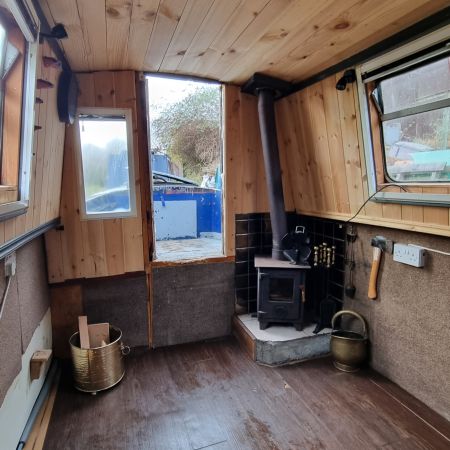
On the 1st of December 2025 I purchases a steel hulled narrowboat after departing the Royal Navy. It was in a state is disrepair due to the previous owner absent mindlessness. He had lived onboard the vessel for eight years & was rather relaxed regarding the maintenance required to keep water bound craft in the best of conditions. However the hull was in good shape, bulkheads (walls) watertight and the engine was functional- everything you need to sail out. Toilet, log burner & gas oven all worked too. Shower & taps were none functional but some faults are to be expected with any purchase of what is essentially a mobile home.
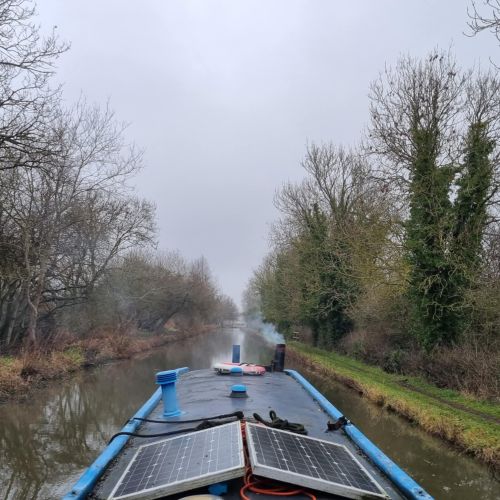
To play catch up for the lack of past maintenance I arranged for the boat to be lifted out of the water at a dry dock facility. This is so the hull could be re-blackened- a process where the underside of the boat is coated with bitumen to project the steel from abrasion. Alongside the installation of new Anodes- sacrificial blocks of Magnesium which react to the water’s natural electrical currents. They corrode instead of the steel, if there are Anodes present the rest of the boat endures. It will under go a engine & gearbox service too- to ensure safety & longevity.
The journey was only 17 miles. Not far, right? Only the boats top speed is a mindboggling 4mph and due to the lack of use; old dirty filters, loose fittings etc I could only push the engine to 2 ½mph.
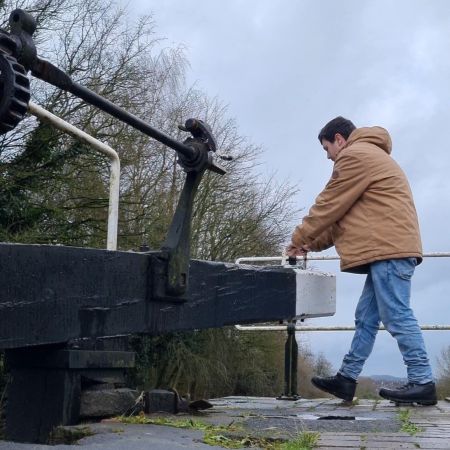
The journey took us through 38 locks- water elevators designed to raise the boat up or down inclines, each taking around 10-20 minutes to operate as the process of emptying and filling the locks sadly varies depending on the locks condition. Some of these locks are over 100 years old, others were renovated 25 years ago.
No motorised help, it’s all relies on physics & is a two person Job. One opens & closes the gates, raising or lowers the water level as another sails in & out of each lock. In the End the journey took three days- six hours of sailing per day.
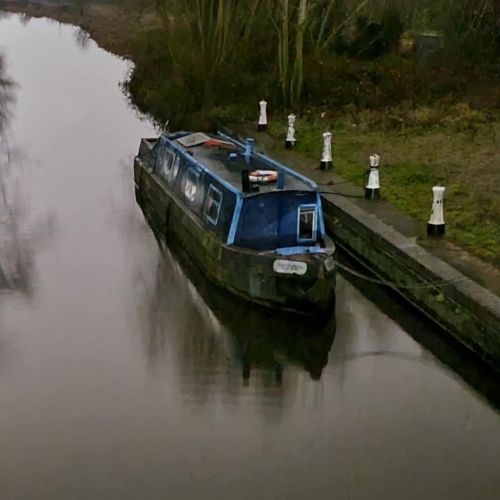
Now fortunately the old canal system left a series of traditional pubs littered across the network, many having been modified into hotels after the industry dried up. This means you can almost always obtain a hot meal every four-to-five mile down the trail. Along with this some of the old lock houses have been converted into cafés and local tourist traps. Where in America, Australia and other large countries have truck stops we have boating pubs which was a big boost to moral as we travelled. Mooring overnight was as easy as finding a free mooring- there are no limits on single night stays only long-term moorings.
The boat is now at the dry dock, has been for two weeks now. Poor weather has hindered all the maintenance but once it’s returned to myself I’ll post updates regarding all of repairs.
Renovating the exterior.
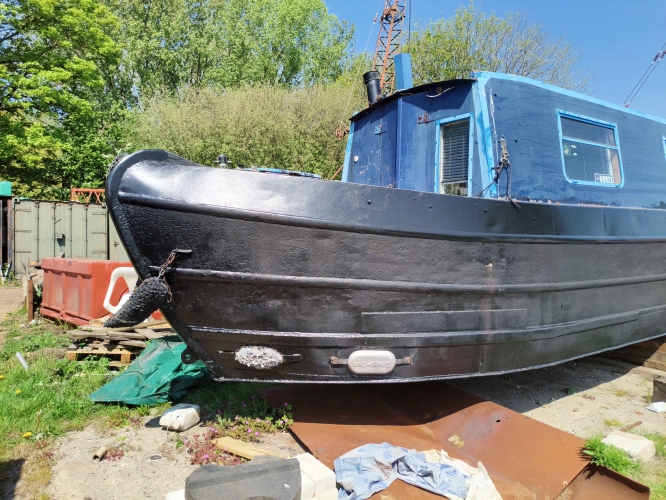
With the boat safely at the Drydock it was taken out of the water so it's hull can be reblackened, as mentioned above it's done using bitumen. The process is simple, the prevous layer is sand blasted off and a new layer is applied. This is to add protection against wear and tear whlst sailing, it scatches off when impacting debris in place of the steel hull itself. You'll also notice the two magnesium Anodes, one is new whilst the other was inherited from the previous owner. These are sacrifical metal blocks that prevent galvanic corrosion of the hull should that be worn away. There are four on the bow, two on the stern and they'll melt away completely after a few years. Untill they're gone you have protection against passive corrossion.

With the lower hull reblackened I worked towards renovating the rest of the exterior. That meant alot of sanding by hand ;~; I couldn't afford to have the hull profesionally painted so I did it all myself and I'll be honest I only removed the previous paint that easily broke away, meaning the end result is a little uneven. The paint came recomended me by the staff at the drydock. Jotun Conseal TU. a 20L can costed £240 but it coated the whole boat (three layers thick) with some remaining to patch up any scratches and scrapes I'll inevitably make during my travels.

And once everything had dried she was lowered into the water. I added some instustrial rubber to the flooring of the front deck and painted the door & interior of said the deck using anti-rust paint. Nothing special just store brought as it was only ever going to be an accent colour to the primary lilac. I haven't got arround to removing & re-adding anti-slip surrfaces that surround the hull but that's something I can do slow time. I'll post beauty shots at a later date but in the meanwhile I think the Boat is progressing nicely.

For the rear I decided it should be an inverse of the front, where the bow has a grey door to break up the liliac I wanted the rear to have an more clean look. The engine compartment lies underneath after all. So the primary colour was switched to a military inspired grey with the door being the highlight. Whilst a professional paint job would have been preferable given my finite funds I've come to appreciate my own handywork. Oh and the John Deer sign was a addition made by my girlfriend, the best part of the having a steel hulled boat is magnetic signs work without damnaging the paint. Customise without concequence!

Above is the complete side profile, the windows still need to be stripped of their original blue paint but past that I'm happy with how the boat appears. I still haven't settled on a formal name at the time of writing but that will come later on. I'm torn between her original name "Delta Vee" or naming her after a fictional character with strong ties to the water such as Neri or Nadia.
If you recongnise those two names why yes I am old and clearly so are you.
Near explosive engine woes.

So, upon purchasing the boat and hiring a gentlement to help me re-wire everything (as I had no idea where any of the disconected cables went) we sailed for three days to the dry dock! Where we were told by the mechanics that for our entire journey we had been sailing a bomb. One of the cylinder heads have cracked, we knew the engine struggled to start but I had wrote this off as being the result of it being a 50 year old diesel engine that needed to be warmed up. Yet after being informed of the cylinder crack what we were actually doing was flooding the engine with fuel vapour to such an extent it would fire despite the leak... Flooding the engine engine compartment with said vapour in the process. If our battery has sparked there was a serious chance of an explosion. woopsie.

Our engine is a BMC 1.8L, British Motor Corporation four cylinder inline engine capable of roughly 56 break horse power or 1,798 cc. I think. The engine is original to the boat yet the exact year of manufacture is unknown so I can only place it down to a decade at best and even then these engines were surplus from the decade prior. For the cylinder crack to be repaired all the pistons had to be remove, the cylinder cover repaired and all the various gasket seals replaced. The manufacture no longer exists so simply ordering new parts was a big nono.

The first thing you'll learn about narrowboat is no new parts being manufactured is a none issue, over the years all the surviving boat yards & dry docks have gathered a surplus that remains in circulation. Acquirng the specific parts was the issue as I couldn't porvide the exact engine specifications and despite his amazing skill the mechanic wasn't a walking encylopedia of BMC knowlege. So the engine repairs took another eight months. This was partly my fault for stating there is no rush, but it took that long to source the correct replacement parts alongside fitting my comparatively low mainenance repairs inbetween the more pressing "Oh God it's going to sink" repair work others needed. Making sure the engine starts is important but take it from me, that doesn't mean work isn't needed.
The floor fell out.

This is pretty self explanatory, due to the previous owners neglect the floor has begun to colapse. Every aspect was rotting and infected with a black mold so I had to replace it all. The entire boat's flooring (bar the bathroom) needed immediate replacement, the walls needed sanding down and the interior treated for mold. Taking a look at the state of what was once the kitchen will show you how bad the dammage was.

So I went out and purchased some 18mm thick MDF board and cut it to measure. The hallway was a single panel whilst the front and rear compartments were made up of five panels each. For underneath the flooring I had to lay down absorbing powder to capture the residual water from the previous owners failed plumbing, once dry I simply vacuumed everying up.

After the floor panels were laid out I simply got my hands on some carpet from facebook marketplace and some new vinyl flooring. I wanted there to be a distinction between the primary hallway. Walkway? The spine of the boat and the individual compartments. Grey was chosen as it's a bright neutral colour whilst a splash green is present at the rear compartment. On the right you can see the exposed panels and how the plates interconnected them. Whilst there was probably a smarter way to have the panels align and avoid trip hazards I just brute forced it using the metal brackets.

There was no real need for insulation beneath the floor as the gap between the hull and the flooring provided an air buffer, although if you're beyond 175cm tall good luck standing up. The support beams are all steel and meld into the the hull so I wasn't going to alter anything. I retained the previous carpet present on the lower walls as that was free insulation whilst the top walls were sanded down and repainted with a matt white to help with illumination.
If you find yourself looking at a boat and it needs new flooring don't fret, it's an easy job if you're good with a saw.
The bathroom drama.

What you're looking at on the right is a slump pump, it's a filter that prevents polutants from reaching the water. You see, on a boat your shower will drain out into the waterways as (Assumming you use biological cleaning products) it won't polute the enviroment. This pump captures hair, skin and any other material that may clog up your external waste pipe or could otherwise pose a swallowing hazard for fish. On my boat it's being used for the entire bathroom, both the shower and sink flow through it. See how clean it is?

This is what I was left with, and whlst it isn't visible in the photo it was filled with a blackish grey sludge. Months, if not years of material that was never cleaned to the extreme it killed the pumps electric motor and clogged the waste pipe all the way back to the shower drain. Disgusting. Yet I had to fix it. So how did I achieve this? First I attempted to use a manual syphon drain the waste it a bucket. The sludge was too thick. A new plan was needed.

So I brought over the left over absorbing powered I had used to dry out the boat during the floor insulation.
The sludge was too thick, the powder absorbed the top layer but it couldn't penitrate any lower. So I had to don gloves and manually rip it all out. The whole thing smelt like rotting flesh. Afterwards I had to then clean out the pipe using a custom made brush, threading it up said pipe whilst flooding water down the shower drain... Several times. Yet through perseverance I was victorious and the pump was replaced.

The pipes work as followed, the green pipe is the outlet which leaves the boat, the mess of a white pipe is the shower inlet, the grey pipe is the sink inlet whilst the black pipe contains the electrial wires. The pump is automatic so aslong as it has power and it detects water it will turn on. The toilet has a removable septic tank and it uses generic blue toilet fluid for flushing. It's a glorified camping toilet. Simple and clean whilst the water supply to the shower & sink is provided by a electric pump over in the kitchen. Currently (As my mooring includes a dedicated shower) I don't use the shower yet and this allows me to share my bathroom with my cat. A little odd but space is at a premium. The pump itself is underneath the checkered flooring, whilst I should never need to access it I made a perminat access hatch because I never want to deal with the mess the previoys owner left me. I will be cleaning the filter when the shower is in use, but for the mean while a shore based shower is nice.
A place to sleep, a place to eat.

So by this point I've repainted the exterior, replaced the entire flooring and for lack of a better term I've factory reset the boat. So it's time to finally decorate. All in all I have 5 meters in the front to work with. (The interior is 2m wide) The area at the rear is the kitchen, in the picture you can see where the sink will be and above it the new boiler for hot water. It will be a small kitchen, no oven just a gas hob but that's all I need. I've sanded down and treated the lower white walls with anti-mold paint and with this in mind I went out and started with the largest item first, an fold out bed, luckily I managed to get a steel framed double sofabed which I had to seperate into two parts inorder to fit it through the door. Once that was present I could work the rest of the furnature around it.

What you see on the left isn't what the boat looks like now but it is what I started with. I wanted to give the whole thing a cozy log cabin vibe and whilst it's littered with nerdy trinkets I think I suceeded.
The log burner was cleaned, you can see how much space the sofabed takes up but it can still fold out for when my girlfriend visits. It just goes from the far wall right up to the book shelves. Speaking of the book shelves it's recycled, we sawed in half a older shelf a neighbour was throwing out and it wound up being the exact right size to slot neatly underneath the wooden cladding. The larger books (Mostly TTRPG, Art & History books) extend a little further out whilst my novels & manga fit neatly on the smaller shelf. Posters had to be hung from the ceiling due to the lack of wall space and that's it. The rest of my posessions, mostly my clothing remains in the rear compartment.

Having lived in Naval Cabins & other military accomidation for the better part of a decade I became acustomed to not owning alot. Don't get me wrong I'm a minor book fiend but everying I owned had to be stored in my van. Compared to a Volkswagen T4 the boat is a huge upgrade in terms of space, having my posessions be out and accessible rather than stored away in boxes 24/7 if a massive upgrade. Having a Van also helped with obtaining furnature for both myself and my girlfriend. We never had to worry about organising deliveries; if it would fit we would take it. The sofa bed being a prime example. If it wasn't for the wooden cladding I would have followed through with my original idea of decoratin the boat in a similar way to my van, large tapestries on every walls but I adore of living in a log cabin. With this in mind on a nice sunny day or at night with the fire burning the boat becomes a close substitute.

Speaking of moving my remaining posessions into the rear compartmemt. Behold! My office! (The clothing rack is just out of frame on the left) And yes that is an Imac G3, specifially one from summer 2000. It makes for a good digital typewriter and it's 16mb ATI Graphics card is perfect for retro gaming. Period appropiate Deus Ex & Myth II. Underneath it is alot of Board games. I used to run a gaming society back in University and I introduced a few sailors into tabletop gaming whilst in the Navy, it's always good to have a surplus of games. It's a little chaotic but every game is accessible. Oh and to loop back to the Bathroom drama the little door you can see in the hallway is how you access the removable septic tank.

Finally we have the kitchen and whilst you may expect lots of cupboards I had a differient idea. Since I live with a cat I wanted the boat to be as open plan as possible so he could have the more space as we're sailng. So I made the kitchen as bare bones as it is practical to do so. The pans hand from the ceiling, all the cups, plates & bowls are stored on shelves above the sink and I obtained a drinks cabinate to hold bottles of water and other juices. The dual gas hob is just a camping cooker nothing special there that runs of removable butane gas canisters which you can see a few of under the sink next to a box of cleaning supplies. Fire extinuishers are a requirement as per BSS Boat Safety Certificate (A mandatory safety check you have to undertake every four years. Paradoxically it doesn't check the boat's hull just the internal gas & electric) and have three onboard. One in the kitchen, one next to the log burner and one in the rear compartment as a back up.
Boat cat time!

Nothing too special about this entry, I just figured after mentioning I had a cat on several occasions it would be a good thing to show him. No he isn't named boat cat but I'll refrain from revealing his actual name. The goverment may know everying about me but this little guy is still anonymous. He's chill, often peers over the side to interact with the ducks & Koi we sail past. He's curious about the water as it ripples yet has never jumped out which is a relief. Whilst I would never advise having a large pet reside on a boat smaller animals will have plenty of room. Just consider a GPS tracking collar encase they decide to have a solo advanture. Luckily for me he's a very lazy cat, we often leave the doors open for air circulation and he really leave despite have the freedom to do so.
Praise the Sun God for it provides electrcity!

My boat came with two 240w solar panels. You can see them mounted to the roof in the earlier pictures and then they disappear. Theres a reason for that. Whilst the solar panels worked the boat lacked an inverter & the internal wiring was shot. This meant the boat wouldn't pass it's safety checks so I ripped it all out as no electrics becomes an automatic pass. Problem averted. So how do I get power?

I use a portable system made by VTOMAN, I highly recomend these guys as I was already using their products in my old Van. The solar panel is 110W but you can upgrade to 200w should you need it. The power station itself comes with two 110v sockets, three USB Ports, a USB-C, a 12v socket and a proprietary adapter for jump leads. The techical specs state it puts out 268w/h and I have a better extender that doubles it's capacity.

The power station can be fully charged with 6 hours of direct sunlight, on a cloudy day you're looking at 10 hours which isn't ideal for winter but it's overkill for summer. The battery extender charges sequentially so once the main unit reaches 100% the second guy kicks in. Wall charging both takes arround 4 hours depending on the voltage provided. Considering that battery lasts for a week without the extender you can easily top it up and prolong a charge. The panel itself is water ressistant but I bring it inside at night.

But you may have noticed a suspicious orange cable running across the roof. What is that for? That's for the power block should I need to charge the batteries in an emergency. I exclusively use it to charge my laptop whilst everything else: Phone, Internet, Lights & other rechargable devices run off the batteries. Four full charges of said laptop would drain the power station as it's a Victus gaming laptop and it eats power. The power block is intended for use in tents and it hooks up to an outdoor campervan socket. Honestly it's a perfect little all in one system, three 24v socks, and pair of USB-A & USB-C's.
Staying warm in the winter.

It's now mid October at the time of writing and whilst the days are still lovely and warm the nights are getting colder so it's time to heat the boat! Which is where I runs into a few legal issues, mainly that the United Kingdom made using solid fuel to heat your home (fire places) illegal in 2021. Their reasoning being "it will reduce carbon emmissions" despite this putting more strain on the energy grid. Increasing carbon emissions and the nations reliance on imported gas. Also burning wood is far less of a longterm polutant than finite mass lithium storage.

Sincerily the UK ceased building new nuclear reactors in the late 1970's, replacements are under construction but thats it. No expansions. Lithium is not recyclable & it requires the same levels of reinforced storage as nuclear waste. Nuclear radiation is actually less destructive than lithium as expired lithium cells will poison the ground if burried whilst incinertaing them creates a guranteed carcinogenic. Should there be a radiation leak life has been proven to adapt. Solar & Wind is great but both require energy storage as neither are a reliable 24/7 all weather condition solution.

Tangential rant over how did the fifty five throusand plus boaters react to this ban? We ignored it, primarily for three reasons:
1. Boats are not classified as permanent dwellings.
2. The inland waterways do not fall under council govervance, they hold no power over us.
3. Without solid fuel people would freeze to death.
The only possible alternate would be constructing a propane heater and such a thing is also illegal.
So the dry wood & charcoal will be burnt.
I just need to replace the lone cracked insulation brick inside my log burner, see the thermal pic. Top right hinge from the units perspective. Once the brick is replaced the whole unit except for the window/exhaust will be purple.
last update: 11/10/2026